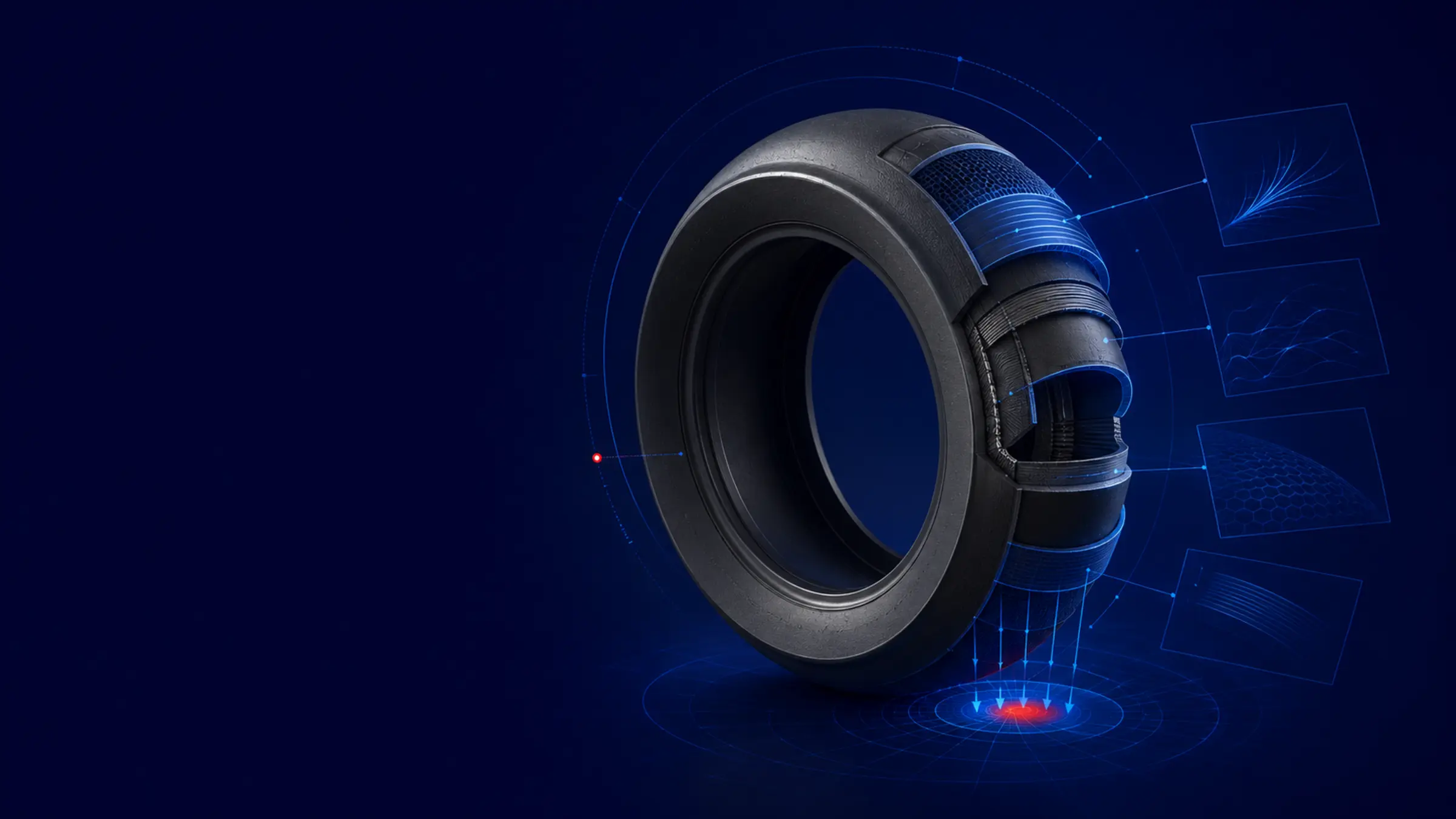
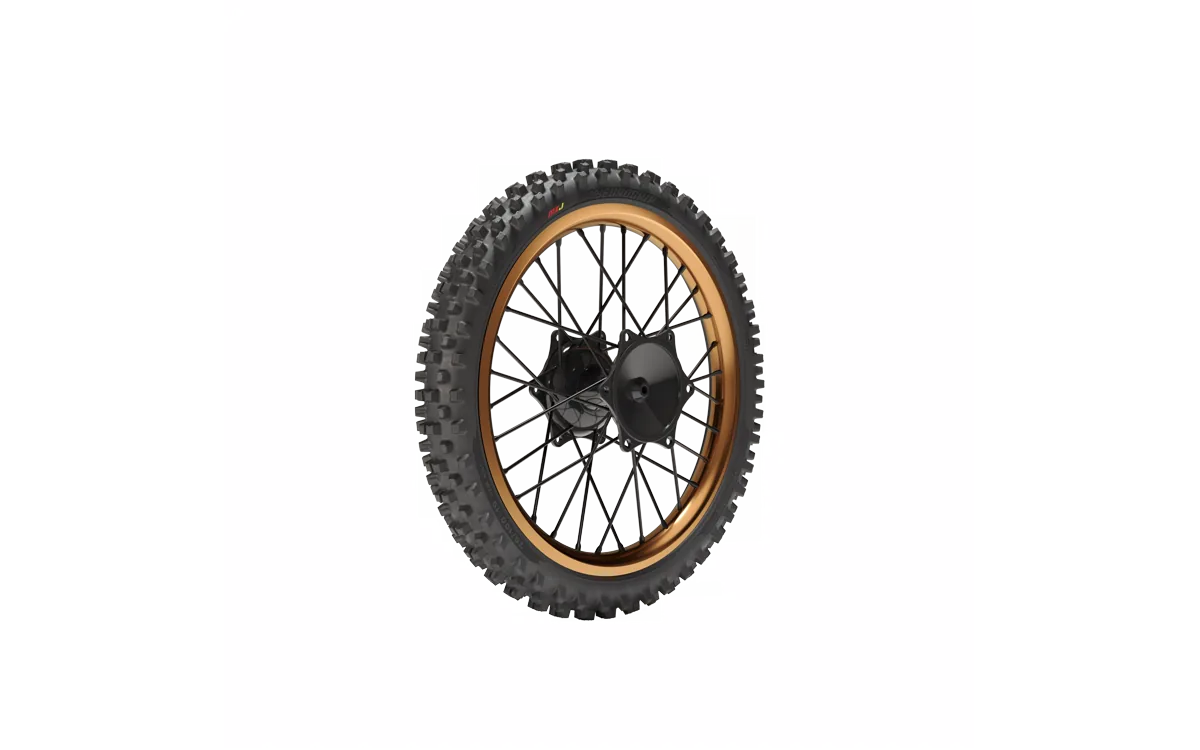
0° steel belt radial construction
The steel belt under the tread is wound parallel to the direction of rotation, so the shape holds at speed.
Press
TOURENFAHRER
Wound at zero degrees over the radial casing, the steel belt restrains a tread that centrifugal force is trying to expand.
The rider sees the result in two places: stability at speed and less deformation in corners. The construction is used across the Trailhound family.
1 sources
-
Press
— document: Trailhound Wild Review by TOURENFAHRER, "Main Features"
High-silica compound
A compound with raised silica content improves grip on cold and wet asphalt.
Press
Moto.it
Rubber stiffens as it cools and loses grip. Raising the silica content keeps the compound flexible at low temperature, and the contact patch also works better on a wet surface.
The compound is used in the Bee Wild and Trailhound families.
1 sources
Quadrazone multicompound
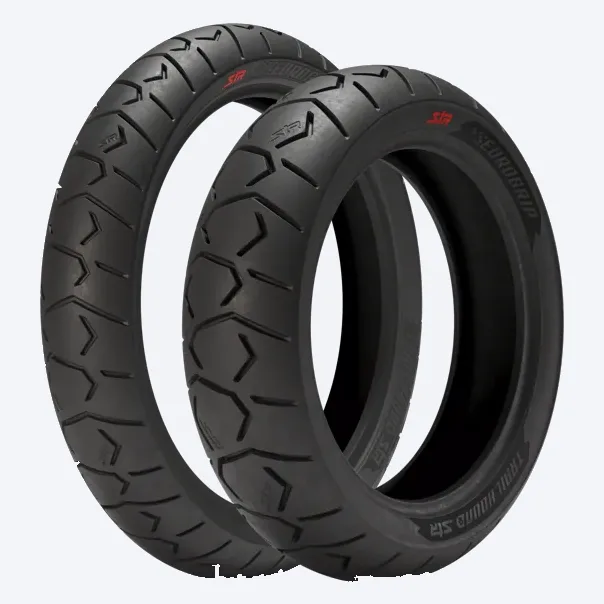
On selected Trailhound STR rear sizes the tread is built from distinct compound zones, each with a different job.
Press
1000PS
A single compound cannot do everything at once: the centre needs low rolling resistance and mileage, the shoulder needs cornering grip.
Quadrazone separates those demands into zones across the same tread. The technology is present on selected Trailhound STR rear sizes; the front tyre does not carry it.
1 sources
Symmetrical knobs — the tyre can be reversed
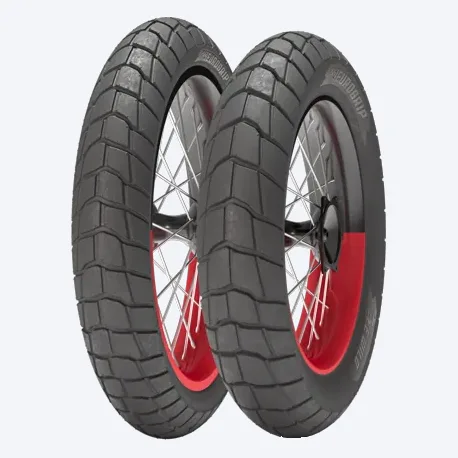
On the Climber XC-R the knob geometry is symmetrical, so the tyre can be refitted the other way round once one side is worn.
Press
Endurista
On an enduro tyre, wear usually collects on one side. Cutting the knobs symmetrically allows the tyre to be turned around on the rim when that side is gone.
This is not a performance claim but a construction decision about service life. The Climber XC-R is designed to comply with FIM Enduro rules.
1 sources
1000PS — Trailhound STR road test
1000PS rode the Trailhound STR on a Suzuki V-Strom 800 for 350 km from Barcelona to the Pyrenees.
Independent test
1000PS
The route climbs from the Mediterranean coast to Coll de Pal at 2,106 m; warm coastal curves, patched asphalt, light gravel and mountain passes carrying meltwater all fall inside the same test.
The test belongs to an independent publication; the report and video can be read from the source link.
1 sources
DueRuote — control tyre in a comparison test
The Italian publication DueRuote fitted the Trailhound Wild to both bikes while comparing a CFMOTO 800MT-X with a VOGE Valico 800DSX Rally.
Manufacturer bulletin
DueRuote
Fitting the same tyre to both machines in a comparison test exists to take the tyre out of the equation: what is being measured is the motorcycles, not the tyres.
This is not a review and carries no verdict on the tyre. The record has two sources: the claim comes from the manufacturer's own bulletin, the test video belongs to DueRuote.
2 sources
-
Manufacturer bulletin
— document: Eurogrip News 1/2026, "IN THE MEDIA"
-
Independent test
—
view source
Endurista — Climber XC-R Supersoft test
Endurista Magazine tested the tyre on a TM 300 2T Corse 2026 in the hills near Rimini.
Independent test
Endurista Magazine
The route at Villagrande di Montecoppiolo took in mud, wet rock, slippery climbs and river sections; the publication described the conditions as "almost extreme enduro".
The Climber XC-R Supersoft is designed for slow, technical enduro and is the softest of the three compounds. The test belongs to an independent publication; the video can be watched from the source link.
1 sources
InMoto — Trailhound STR and Wild test
InMoto rode both tyres on a Honda Africa Twin 1100 Adventure Sports at the Vallelunga proving ground and the roads around it.
Independent test
InMoto
Because the same motorcycle and the same route were used for both tyres, any difference comes from the tyre rather than the bike or the conditions. The STR is designed around 90% road / 10% off-road, the Wild around 70% / 30%.
The test ran mainly on paved roads with a few light off-road sections. It belongs to an independent publication; the article and video can be read from the source link.
1 sources
Moto.it — Bee Wild test
Moto.it rode the Bee Wild on a Honda ADV350 for roughly 500 km in Sicily.
Independent test
Moto.it
The test covers city streets, motorway, winding secondary roads and compacted dirt tracks, with the first 100 km deliberately spent in town.
The Bee Wild is designed for 80% road and 20% off-road use. The test belongs to an independent publication.
1 sources
Moto.it — Trailhound Wild test
Moto.it rode the Trailhound Wild on a Honda Africa Twin for roughly 500 km in Sicily.
Independent test
Moto.it
The route covers four distinct surfaces: around 100 km of city riding, motorway transfers, mixed mountain roads around Mount Etna and compacted dirt tracks.
The Trailhound Wild is designed around a 70% road / 30% off-road balance. The test belongs to an independent publication; the article and video can be read from the source link.
1 sources
Motoretta — Bee Wild test
Motoretta removed the original tyres from its own Yamaha XMAX 300 and fitted the Bee Wild.
Independent test
Motoretta
This is a swap test: the reference point is the tyre the machine left the factory with. What was measured is stability, steering precision, braking and acceleration, on asphalt and on light off-road.
The test belongs to an independent publication. ⚠️ The file we hold carries no public link; the source is listed below as a document, with the publication and section named.
1 sources
-
Independent test
— document: Bee Wild Review by Motoretta, Yamaha XMAX 300
MotoTaller — Bee Wild long-term test
The Spanish publication MotoTaller ran the Bee Wild on a Honda ADV350 for more than 2,000 kilometres.
Independent test
MotoTaller
The test covers city riding, country roads, motorway, wet surfaces and light dirt. What separates a long-term test from a single ride is simple: only time shows how wear distributes across the tread.
The test belongs to an independent publication; the article can be read from the source link.
1 sources
Roadbook — Trailhound Wild test
Roadbook tested the Trailhound Wild on a KTM 890 Adventure R.
Independent test
Roadbook / Motorrad Italia
The Trailhound Wild is a knobbed adventure tyre built around a 70% road / 30% off-road balance; the groove layout is shaped for water evacuation and self-cleaning from mud.
The test belongs to an independent publication; the article and video can be read from the source link.
1 sources
SiCAR (Taiwan) — Trailhound STR test
The Taiwanese publication SiCAR tested the Trailhound STR and published its review on its own channel.
Independent test
SiCAR
This record comes from a market outside Europe; the same tyre was tested independently in a different climate and on different roads.
⚠️ We do not describe the scope of the test here: the review is in Chinese and we hold no transcript, so we do not know which motorcycle or which surfaces were involved. The video is at the source link.
2 sources
-
Independent test
—
view source
-
Manufacturer bulletin
— document: Eurogrip News 2/2026, "MEDIA REVIEWS"
TOURENFAHRER — Trailhound Wild test
TOURENFAHRER, the German magazine specialising in adventure riding and motorcycle travel, tested the tyre on a BMW R 12 G/S.
Independent test
TOURENFAHRER
The test started in mid-June and covered both asphalt and light off-road, with the publication paying separate attention to the first kilometres on a cold tyre.
The test belongs to an independent publication. ⚠️ The file we hold carries no public link; the source is listed below as a document, with the publication and section named.
1 sources
-
Independent test
— document: Trailhound Wild Review by TOURENFAHRER, BMW R 12 G/S
The records on this page are not product promotion; they present documented information together with its source. To check fitment for your motorcycle, use the tyre finder.